Friday, May 20, 2011

Dog Finds Slovenia's Last Snow

Summer has arrived to the Slovenian Alps


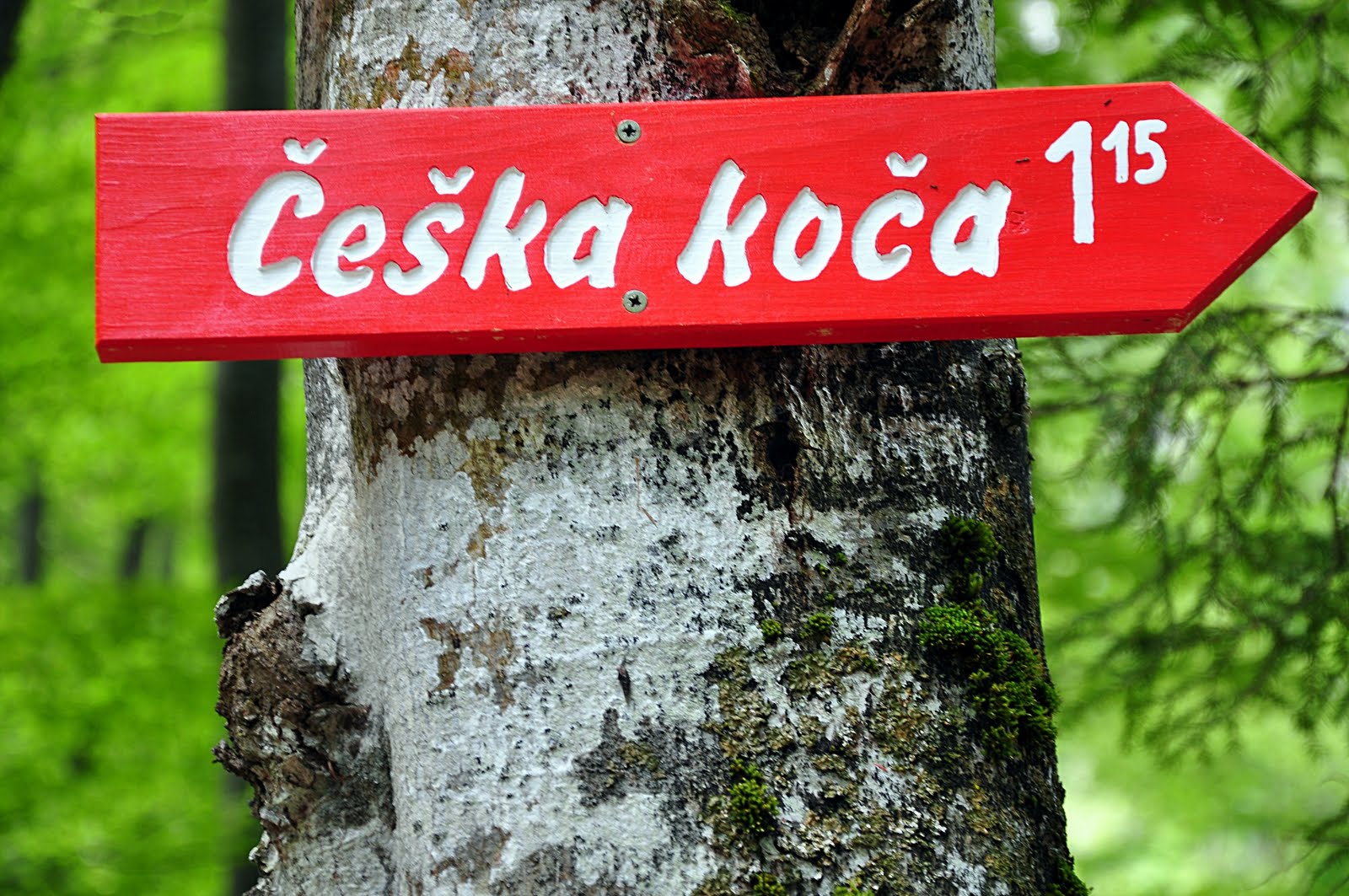
Noon, Saturday in the Kamnik-Savinja Alps of Slovenia. I am at the altitude of 1800 meters, above the Češka Koča hut and in the shadow of the highest mountain in the region, Grintovec.

Despite having dragged my skis through four countries and airports, I had already lost hope of finding any skiing on this trip. But to my surprise I now had snow under my skis. The thanks for this goes to my newly found Slovenian friends: Ana, Matjaž, Urban, and my old friend Jan.

And last but not least, Lana, the climbing dog. Lana has lead the way through the forest paths, rock walls and steep snow faces and brought us to this point.
And what a nice place this is. Not just this mountain, but the entire small country of Slovenia is beautiful. No matter where you are, the mountains are visible. And for the most part, the mountains are unspoiled, covered by thick forests and without scars left by civilization.

There are also pretty fields, castles and cities. I had not visited Slovenia before, and I was also surprised about the state of their their technology. Just one example: its the only country with IPv6 available in all mobile networks.

But getting here seemed to involve an endless number of roadblocks. First, my business took me to a few different countries on this same trip before Slovenia, which meant carrying a lot of equipment around and using luggage storage services while was in my meetings.

And unlike with my usual airline, the airlines on this trip all charged extra for the ski bag, costing all together almost two hundred Euros extra.


And then it turned out that the ski areas that I was planning to visit were closing just a few days before my trip. And finally, when we came up with the backup plan of climbing up on our own, the weather forecast center told us to stay away from the mountains.

But we decided to risk it anyway. We could always turn back if the weather become a real problem. And that was a good decision. With the exception of a three minute shower, we whole day was sunny. We parked our car at the end of a small road and started the climb through a thick forest at an altitude of 1000 meters. This was an easy walk along a well-marked path. A bit later the path reached a more rocky area, involving a few sections with ladders or safety wire handrails. (These posed a small challenge for Lana, as the young dog needed more climbing experience.)

The Češka Koča hut acted as our base of operations five hundred meters higher. A week ago, the snow reached the areas around the hut, but now we had to walk a bit further.

With Lana in the lead, we climbed through scree slopes, rock outcrops, and finally, a steep gully of soft snow. (By the way, it seemed far too easy to climb with four legs.) At an altitude of 1800 meters we reached a plateau. It made no sense to continue, as there was not really any snow in the rock faces above.

Skiing down the steep gully was fun, as the snow was just soft enough to get a good grip but not to create a wave of wet snow ahead of me. Further down I realized that I had to make slalom turns around the small rocks that lay on top of the quickly melting snow cover. It was not a complete success; I'm guessing that the guys at my ski maintenance shop will give me yet another lecture.

Even further down I found another gully that led past the hut, but the snow cover narrowed down so that I had to cross a few sections without any snow; more trouble for my skis. I stepped carefully over the stones and continued skiing. I finally arrived at the end of the snow and walked back to the hut.

As we walked down and started to leave, my friends had another surprise: we had an opportunity to meet Davo Karničar, the Slovenian climber and extreme skier. Davo lives near the start of the trail towards the Češka Koča hut, and his father actually owns the hut.

Davo's name is not too familiar in the western world, but this man might well be the greatest extreme skier alive today. His achievements include being the first skier to ski down from the summit of Everest and the first to ski down from the seven summits. He has also skied from the Eiger and Matterhorn, and made countless other descents. An amazing man!
The essential parameters for skiing at the hut are as follows. The hut is in Jezersko, just 30 kilometers from the Ljubljana airport. The hut is at 1542 meters in the slopes of Grintovec (2558 meters). I got 300 meters of vertical on my ski down the slopes above the hut; in the winter far bigger parts of the mountain are skiable.

The recommended climbing time to the hut is 1 hour 15 minutes, and that held pretty well even with large amount of equipment we were carrying (though Urban tooks turns to help carry the skis - thank you!). It took an additional hour to climb to the plateau, and five minutes to ski down.

There are also commercial ski areas in Slovenia. I had originally planned to ski in Sella Nevea - Bovec, a ski area that links Italy (Sella Nevea) and Slovenia (Bovec). They were still open on May 8th, a week before my trip. Sella Nevea would be excellent addition to any trip to the nearby Venice, by the way.

As I am finishing this blog entry, its already next week -- my first week this season that I am not skiing somewhere.

I did travel to Berlin and I would have tried their infinitely long indoor ski slope, but unfortunately it was not open the day that I was there. It certainly feels like summer is taking over.

Oh well, at least I booked a vacation in Norway for next month. Hopefully there will be some skiing in Stryn. With Slovenia being 19th country or state this season, Norway could be the 20th.

Green mountains of Slovenia
Dog waits for the slow human climbers


Photo Credits (c) 2011 by Jari Arkko, Urban Kunc, and Matjaz Stepancic

Sunday, May 8, 2011

90 Minute Ski Trip to Haarlem

Helmets

   I stare at my flight tickets. If my flights are on Saturday, why does it say Friday on the tickets?
The slope

As a week of marathon meetings is now over, I was looking forward to some relaxation. This was supposed to be a two helmet trip where I could do both some skiing and biking. With very few exceptions, all my business trips are at least one helmet trips; if all else fails, in most places you can at least rent a bike for an evening tour around the city. Actually, for health reasons I need at least that amount of exercise every couple of days. In exceptional places and with trips lasting through weekends, I may be able to get a three helmet trip by going biking, skiing, and climbing.


But now I may have a dreaded zero helmet trip, as my flight is taking off in just three and half hours. I decide to
Riding in the taxi towards the ski area
try to squeeze the skiing in anyway, even at the risk of possibly missing my flight. I throw everything into my suitcase, pay my hotel bill and grab a taxi from the street.

I am about to ski in the Snow Planet, an indoor ski hall a few kilometers outside the city of Haarlem, Holland. Not Harlem, New York.

The Dutch and the Japanese are world leading builders of indoor ski halls. One of the Dutch halls, Snow World in Landgraaf, is the third biggest in the world. Snow Planet is not big, but its what I am trying to ski today.

Outside view
But first I have to get there. It takes a while to explain to the driver where I am going, and what is this concept of "skiing". And the Amsterdam city traffic is painfully slow. After a 40 minute drive we are finally there.

The entire facility seems modern and well equipped. There are three ski lifts, two exceptionally fast button lifts for indoors, and one moving
Ready to ski
carpet. The main slope is short. It is also not very steep, but unlike many other indoor ski runs, I find that its still steep enough to make actual turns. In addition to the main slope there is a short and almost level beginner's area.

A big part of the main slope is dedicated to jumps and rails. It is almost hard to find a passage through the slope without going through them. While I was there, much of the rest of the area was consumed by a kids training race track.

Lift ticket
At the top of the slope you can climb a few steps on top of a platform that drops a meter or two almost vertically at the beginning. Nice touch.

The essential parameters for the Snow Planet are as follows. One hour lift ticket is 19.50 € and a day ticket 26 €. The length of the slope is 230 meters. Soup of the week costs 4.50 € at The Lodge.

There is also a sports equipment shop and a rental facility. But if you accidentally forgot to pack ski clothing for your Netherlands trip, you are out of luck. They do not rent clothing.

View from the top
The ski area is 26 kilometers from the Schiphol airport and 30 kilometers from Amsterdam city center. My ski run down the hill took 20 seconds, but I made turns.

I stayed at the ski area for half an hour (including changing gear), and the ride back took 20 minutes, making us spend just 90 minutes on the entire excursion. I made it to my flight, too.


Photo credits (c) 2011 by Jari Arkko

Monday, May 2, 2011

Skiing Kauniainen at 3AM

Kauniainen, whopping 50 meters below
May, 2011. Its 3AM and I'm about to ski the local ski hill in Kauniainen. May will be my sixth month here, as the season started in December. That's quite a season for a ski area in the most southern part of Finland.

Strangely enough, the area was closed a month ago. But not due to lack of snow. Even now there's enough snow to ski down, though the night helps by making the snow a bit more firm. Still, as I climbed up I kept sinking to my knees and occasionally deeper.

The ski hill in Kauniainen is not big, its just 50 meters high. But its close, I could walk here from my home, and if the city didn't spread sand all over the walking paths, I could probably slide back home on my skis. Skiing here for an hour in the evening does
Sky colours
not waste time for travel. My kids learned to ski here. The local ski club, GRIFK Alpine, has a ski school that lasts for the whole winter and teaches 500 kids every year. Their training program is also highly acclaimed, one of the local kids is now a world cup racer. From this hill! Though one has to wonder how six year old trainees can ski the race track day in and day out, and then spend their evening watching video recordings to make sure their knees are at exactly the right angle in the turns. In any case, an impressively well organized club!

Climbing up in darkness
But back to this night. Why am I here? Its not much of a ski run, but I wanted to say that I skied here in May and photograph what the area looked like in the middle of night. Or you could say that I'm crazy. This seems like a good point to remind all the kids that skiing in a closed ski area is dangerous and incredibly stupid. Do NOT try this at home. As I climb up I keep watching for some of the dangers, as the melting snow has uncovered junk that I did not want crash into. The slope is almost entirely covered by snow, except for a few such spots. The lift track and flat area at the bottom are free of snow and full of mud, however.

The ski area
This is a historic site, actually. This ski hill was the site of the first ski lift in Finland, in 1934. The old wire lift was still used until a few years ago, literally a pain in the ass. The ski area is owned by the city, a tiny (pop 8,000) but self-sufficient Kauniainen. In addition to the ski hill, there's a lake, the city hall, a train station, one restaurant, one movie theater, a few shops, and a school that pioneers use of open source technology in learning. All you need, that is. In the winter a green, heated grass football field provides contrast to the to the ski hill that sits next to it.


And then there's the off-piste. Before you start laughing, let me point out that with all my skiing around the world, the most dangerous event that happened to me this season was falling to a bush well in Kauniainen. For a moment I thought I would be unable to move, but luckily was able to get myself free. I knew about tree wells, but I didn't realize that snow on top of bushes can collapse under the weight of a skier.

Football and skiing
First, it should be noted that top of the ski hill is easily accessible not just by the ski lift, but also by car from the end of Jalmarinpolku. If you come by this way, make sure you do not block the access to the local houses. There's space to park one car in front of the gate, however. The most interesting off-piste route is on the skier's right, straight down the steep side. This spot is icy and steep enough to be tricky at times. Alternatively, if you ski from the back of the lift and keep turning left towards the ski area, you'll find a number of different routes through the woods.


Off-piste
The essential parameters for Kauniainen are as follows: the price of adult day ticket is 17 Euros and a season ticket is 150 Euros.

They do not sell real food in the cafeteria so I don't know what the Goulash index would be. However, the cafeteria is a nice place for some hot chocolate and pulla! The closest "real" food is available in the Hölmölän Burger Grill (stupid's grill), near the Bemböle School, or alternatively in the one restaurant in the center of Kauniainen.

My nightly ski run took 27 seconds, but in the winter the slalom competitions winning times are usually around ten seconds.


Clouds


Photo credits (c) 2010-2011 Jari Arkko

Tuesday, April 12, 2011

Invasion of the Golfers

Lebensraum for skiers is shrinking
Sunday, April 12th at the Peuramaa ski area. There's still plenty of snow, its +10 degrees, and the sun is shining. But this is the end. Snow is melting fast, nights are not cold enough for snowmaking, the cliffs in Peuramaa's playground are no longer covered by snow -- not that it prevented me from skiing them -- and the afterski restaurant has run out of Pepsi Max.

But more importantly, the little green men are invading. I mean the little men on the green are invading. Sorry, I meant that the men on the green are invading... Whatever. I'm talking about the golfers. Peuramaa hosts also a golf area, and everyone's focus seem to be in starting the golfing season. With the spring and sunshine even the local skiers have forgotten that skiing might still be possible. Thus, this is the last day of the season at Peuramaa.

Not Just Peuramaa

And this is not just Peuramaa. My home hill, Kauniainen has already been closed for
The parking area has turned into a lake
a week. So is Serena. Vihti might still be open for a couple of days, but the little green men seem to be taking over there, too, as they are hosting a ski-golf tournament. This is the end of the season in the nearby areas.

I Need to Find More Skiing

The end of the season has caught me unaware. I am of course hoping that I'll find some more skiing in the coming months. I am traveling again in my work, maybe that helps? Unfortunately, Brussels, Amsterdam, Ljubljana, and Stockholm are unlikely to offer any skiing in May.

I'll also visit Quebec City in July, but
They butchered the deer (peura), too
its again the wrong season. Any ideas on what I could do to still get some skiing this season?

48 Hour Challenge, Take Three

By the way, I discovered the destination for my next 48 hour ski tour: Baltic countries. The season is over there, too, but next year it should be possible to visit perhaps even as many as four countries: Estonia, Latvia, Lithuania, and maybe even somewhere in Russia. Kuutsemäe, 230 kilometers from Tallinn, Estonia, would be a good place to start from. They offer a couple of runs with the "sharpest one" being 15 degrees and the "gentle one" being 13 degrees :-)

Photo credits (c) 2011 by Jari Arkko

Monday, April 4, 2011

Poland Is Melting Away

Mountain scenery in Strbske Pleso, Slovakia
Fail. Noon, Saturday. Despite a 6am wakeup the weekend is quickly turning into a disaster. I could have gone home but wanted to tour ski areas in eastern Europe. The only problem is that the areas are quickly melting away. The first area, Szklarska Poreba, Poland, did have an open lift but only took hikers.

The second area, Karpacz, was supposed to be open but their lift was broken. I'm about to waste my weekend. The parking attend tells me that the hike to the area takes six hours without the lift. I would be tempted to try it anyway, but language problems make it impossible to find out if there'd be skiing after the hike. And my friends, Tero and Heikki have a ship to catch and can not stay long enough to take the hike.


Afterski in Strbske Pleso at the Discobar Plesivec


Time for decisions. Go back to Czech Republic and ski something near Horni Domky, if they would still happen to be open? Go back to Prague and spend the weekend reading e-mail or bar hopping? We flip through the pages of the Lonely Planet and search for alternate sites. Finally, it turns out that there's a ski area in the High Tatras in Slovakia that is still open this weekend.


Climbing up in Zakopane
The only downside is that its far. By this time we've already spent almost four hours on the road, and to get to Slovakia I'd be looking at seven additional hours of driving. Here is the route that I took. This is 1300 kilometers, or 17 hours of driving. I part with my friends, they head for the boat and I take off towards Zakopane, Poland.

When I arrive in Zakopane it is already evening. We were never able to determine from the Polish website if Zakopane is still open, but it for sure is not open at this hour.
Single chair
Not to worry, there's always the option of climbing up on my own. I park my car at the ski area parking lot, hoping that the gates do not close while I'm up there. Or that the personnel try to stop me. (Kids: don't try this at home. Entering a closed ski area is dangerous and should only be attempted by the experts who have left their brains at home.)

I climb up 250 meters to the top of the lift and the end of the snow. This takes an hour and half with all the photography on the way. A quick rest at the top and I need to head down before the light is completely gone. Note to self: this is not the first ski trip where bringing a headlamp would have been smart.

Sunset as I was climbing up in Zakopane, Poland
What I skied down is a ski run near the center of Zakopane, in the Nosal area. There are bigger areas in Zakopane, but the one run from the top of Nosal is actually very nice. It is steep enough to be interesting. And of course, it is equipped with a single chair lift. Scary, inconvenient with a backpack, and no way to make new friends in the lift. But an interesting piece of history.

Karpacz, Poland was melting away
My ski run lasted a minute and 56 seconds, or about 350 times shorter than the time needed for the drive and climb. Its hard to find a worse ratio! But I did like the climb.

From Zakopane I drove to Strbske Pleso, in the High Tatras of Slovakia. Their last day of the season would be tomorrow Sunday. But first I'd need to test their afterski. The recommended place in the nights is Discobar Plesivec, next to the central parking structure. This is a loud disco-style bar with a surprisingly large crowd, given that it was the end of the season.


Unlike the hills in the border between Czech Republic and Poland,
Upper runs in Strbske Pleso
both Zakopane and the High Tatras have real mountains and nice scenery.

Strbske Pleso's ski runs are relatively limited, however. It has a 450 meter altitude difference, and the red run from the top station to the bottom is interesting, even if it has a few flat sections. If I had come earlier in the season, the off piste routes to the skier's left of the main chair lift would undoubtedly been interesting.

The essential parameters for Strbske Pleso are as follows. Goulash index 1.55€. This price is from my hotel restaurant, I had no time to check the ski area restaurants. Time to ski down from the top to the bottom: 2 minutes 35 seconds. Strbske Pleso appears to be one of those ski areas that can be skied down without having to make any turns. Accommodation was 46€, for one person in the nice Hotel Toliar  in center of the village. If had searched online I would probably have found cheaper alternatives. Three hour lift ticket was 14.50€.

Discobar Plesivec, Strbske Pleso
Overall, I succeeded in skiing in three new countries on my business trip to Prague. On the first weekend in Hormi Domky in Czech Republic and now in Poland and Slovakia. This brings the number of countries and states that I have skied to 32. On this season 17 so far. Where next?


My route through Czech Republic, Poland, and Slovakia


Photo credits (c) by Jari Arkko and Google Maps.

Wednesday, March 30, 2011

The 48 hour challenge, take two

Have skis, will travel.

Couple of weeks ago it was northeast United States, now its eastern Europe. I have from Friday evening to Sunday evening and a car. Where could I go?

On the right there is one possible route, stopping (again) in Czech Republic, somewhere in Poland, and in the Tatra mountains in Slovakia.

However, the drive would be very, very long and there'd be only an hour or two to ski in these places. Maybe its time to choose a more relaxed route.

I do want to cover at least one new country, though. Poland is close, right? Is there snow in early April? Are the ski areas open? Or would it be better to travel to Slovakia and ski only there?


Sunday, March 27, 2011

Skiing the Horny Donkey

Advertising gone wrong, very wrong
Yesterday I skied at the Horny Donkey ski area. Well, Horni Domky. This is a small ski area in northeast Czech Republic near the border towards Poland. The highest ski lift goes to 1315 meters and maximum vertical is 690 meters. While small, the area modern, has two fast high-capacity chair lifts, and generally offers nice skiing. The ski area is a part of a group of nine ski areas in the western end of the Giant Mountains: Skiregion.cz. Together these areas have 36 ski lifts and one lift ticket works on all.

My favorite ski run here is the "Slalomák", a steep red run that is best served not by the lift next to it but the slightly longer upper chairlift. The upper part of the mountain was still in winter-like form.

Other good trails include the "Drevarská" (black) and "Cervená FIS" (red). However, given the bad snow year in the central Europe and the fact that its the end of March, these slopes were already closed due to lack of snow.


Not that it stopped me from skiing them, just that a different technique was needed. I was surprised that a wet, steep grass hill sticks to your skis and slows you down quite a bit. Steep is better in grass skiing then, too.


And no, my skis did not suffer from this exercise. This was true grass, not sand or rocks. And it was lubricated by animal dung. I did have to give my equipment a shower back at the hotel, though.

The other way to handle the grass part
I also have to bring up the amazing Goulash index value in the Horny Donkey: 1.5€ for a bowl of Goulash soup. 1€ for beer. 24€ for a high-season day ticket, and we got our 5-hour tickets on a discount at only 16€. Skiing here is cheaper than staying at home and having to buy expensive groceries in Finland. Below you'll find a comparison of the Goulash index across some ski areas.

  • Horny Donkey 1.5€
    Goulash soup 1.5€, beer 1€
  • Mad River Glen 3.5€
  • Zillertal 4.5€
  • Åre 9€
  • Zermatt (a fortune)
  • Peuramaa (infinite, they only sell hamburgers)

I did not check accommodation prices (even if Pension Crazy sounded interesting), but it is clear that a day in Zermatt may give you a week in the Horny Donkey.

Go here for the after-ski
The best after-ski on the slopes takes place at the bottom of the Slalomák trail. This is the gathering place for many tourists, but also for racers whose race track sometimes occupies the Slalomák. The restaurant has tables inside and outside, cheap beer, music, outside grill, and all the other necessary ingredients to attract the crowds.


Sunday, March 20, 2011

Family and Off-Piste Skiing in Åre

Chilly chair lift ride
As far as I can tell, Åre is the best family ski resort on the planet. There are, of course, many ski areas suitable for teaching children. There are many resorts with family friendly facilities. However, small kids are unlikely to ski for a full day and they need other activities as well to keep them occupied. Other activities in the snow or hotel play rooms may help here, but for me Åre is special in that they have a full-blown kid-friendly indoor water park right in the biggest hotel, the Holiday Club. Many resorts have spas and swimming pools, but a large water park is rare. Anything that boasts seven different saunas can't be a too bad place to stay in!

Hotelli Levitunturi in northern Finland comes up in my mind as a similar place, what they lose in the water park side may be offset by their very nice children's play house. But I can't think of any other examples in the world, can you?

Tree skiing near Björnen
Large parts of Åre's ski area have easy runs that can be skied by beginners, particularly in the Björnen, Rödkullen, and Duved areas. Skiing can even start right from the main village, but the runs returning to the village are mostly red and black, so with beginners it may be a better option to use a ski bus or taxi to go to Björnen, for instance. A taxi ride also removes the main downside of staying at the Holiday Club, having to walk a few hundred meters road uphill to reach the ski lifts. In any case, my youngest kid learned to ski the black runs on this trip to Åre. (Hey! My work as a parent is now complete, right?) Maybe I don't have to care about beginner slopes any more.

The entire upper mountain is a playground
But lets talk about skiing for adults. The main ski runs near the village are all consistently steep runs that are a pleasure to ski. My personal favorite is "Lundsrappet", a black run leading to the "VM8" eight-person chair lift. The upper parts of the mountain are largely open space, with wind-blown forms that are fun to ski.

Despite its relatively modest size and round mountain forms, Åre has plenty of off-piste terrain. In good weather, snowmobiles or cats take skiers from the top of the highest lift to the Åreskutan. For 5 Euros, this must be the cheapest cat skiing in the world, along with Copper Mountain cat-included-in-the-lift-ticket deal, of course. At the top you will find a small cafe, a large radio antenna, and wind-blown Swedish mountain landscape as far as you can see.

From the top you can choose multiple descents. The path towards the lifts is the easy and safe alternative. A bit further away awaits Blåstensbranten, an extremely steep run. At 50 to 60 degrees, it should only be skied by experts. If you stand up on Blåstensbranten and extend your hand to the side, you will be able to touch the ground.

Cornice jump near the Tusenmetersliften
A more easily reached off-piste area, "Västra Ravinen" is to the skier's left from the "Svartbergsleden" and "Hummelbranten". You can enter this area in the easiest way from the bottom of the "Tusenmetersliften", or alternatively going right from the Hummelbranten. Entering from the top of the Svartbergsleden will take you the challenging Svartbergs off-piste. Make the exit to the left just before the traverse would take you to the right and down. Svartbergs is also a very dangerous run, there is potential for a cliff fall, avalanches are frequent here, and in the wrong conditions a fall on this slope is a bad idea. I've seen a friend fall here in icy conditions and keep building speed all the way to the bottom 200 meters below (luckily he was unhurt).


Return of the barfcam! (Thanks, Melinda) The above video shows one path from the top of Svartberget to the Västra Ravinen.

Västra Ravinen Off-Piste
Once you reach the bottom of the Ravinen, follow the natural trail until you reach the restaurant near the top of the Åre Bergbanan. Be careful as
Beware of reindeers on off-piste
you are skiing on a river bed. Later in the spring there will be openings in the snow and ice that expose the river. And do not crash into a reindeer!

The essential parameters for Åre are as follows. The Goulash index (price of soup) is 9 Euros. The maximum vertical difference is 890 meters (which can be skied in 3 minutes and 20 seconds, but who is counting). The steepest on-piste ski run is 27 degrees, but this on the almost always closed-for-races ski run, the Störtloppet.

Top of the Svartberget
Åre has plenty of moguls skiing. When we were there a week ago they hosted the one of the world cup races in the "Slalombacken". "Hummelbranten" and, at times, "Lundsrappet" offer also some good bumps. The bumps in the children's slope were a better match for my abilities though.

Åre can be reached by car, a party (!) train from Stockholm, or by flight to Östersund, 100 kilometers away. Taxi transfers are reasonable though, 29 Euros one-way. Send mail to bokning@flygtaxi.se to make a reservation.

Photo credits (c) 2009-2011 by Jari and Olli Arkko